
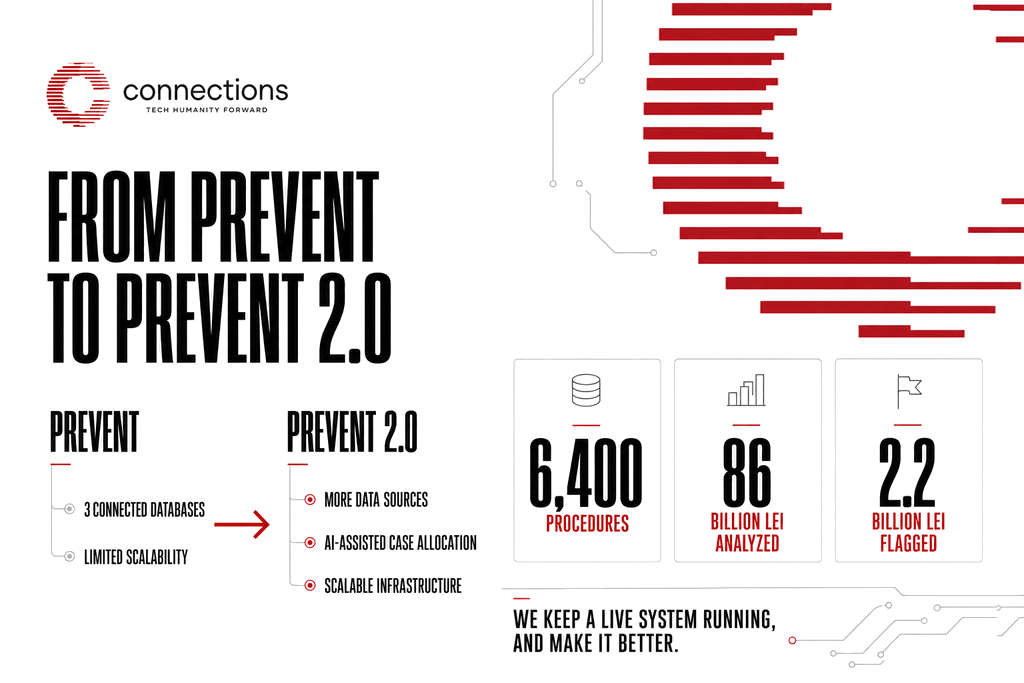
PREVENT, in its original form, was connected to only three external databases: SEAP, DEPABD, and ONRC. A system unique at European level as a model of good practice, but one that had run for over seven years on an architecture with limited connections — while the volume of procedures under review kept growing steadily, from 98,036 procedures (June 2017 – March 2023) to 103,114 procedures (June 2017 – June 2023), with over 450,000 associated subsequent contracts.
PREVENT 2.0 expands the number of government databases queried, with the ability to keep adding more over time, and introduces a unified search engine with dynamic forms generated based on user permissions. Case allocation to integrity inspectors is now handled both manually and automatically, through an AI/machine learning component that factors in caseload and each inspector’s current workload — a concrete application of AI supporting human decision-making, not replacing it.
From a technical and security standpoint, the system was designed for high availability, scalability, and full redundancy, with role- and group-based access control aligned with GDPR requirements and the “need to know” principle. One of the more delicate challenges was extending connections to additional government sources — each institution has its own data formats, access rules, and response times, and synchronizing them into a single flow required both technical and institutional coordination. Integration with recently updated systems, such as REGES, was a pioneering exercise — the first integration of its kind carried out by that system.
Results from PREVENT 2.0’s first three months of operation confirm the need for this upgrade: over 6,400 procurement procedures analyzed, with a total budget of 86 billion lei, and integrity incidents flagged in procurements worth approximately 2.2 billion lei.