
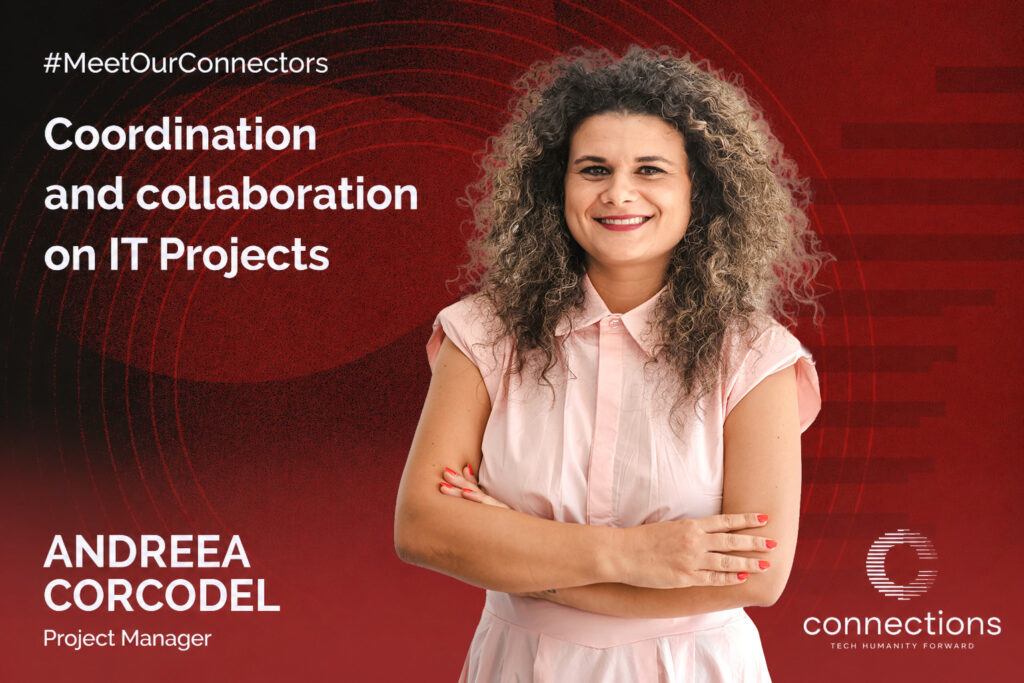
In an IT project, deliverables, deadlines, and technology are only part of the equation. Behind the scenes, there is constant coordination, quick decision-making, and the ability to keep teams on the same page, even when the project dynamics change rapidly. This is the role that Andreea Corcodel, Project Manager on the Connections team, handles every day.
For Andreea, project management is a combination of organization, effective communication, and quick decision-making. In practice, this means constant collaboration between technical and non-technical teams, coordinating stakeholders, and managing unforeseen situations, especially in public sector projects, where processes and decision-making timelines are often more complex.
Beyond the Processes: People and Collaboration
One of the most important aspects of a complex project is the ability to bridge different perspectives. Technical teams, business stakeholders, and end-users often have different priorities and ways of working, and Andreea’s role is to create a shared space for understanding and collaboration. To achieve this, communication must be constantly adapted so that every party understands the project’s objective, the impact of decisions, and the direction the team is heading. Sometimes, this also means facilitating difficult discussions or reaching a consensus quickly.
Beyond processes and methodologies, Andreea believes that a project’s success is largely influenced by interpersonal relationships. Trust, open communication, and team engagement are elements that don’t appear in a project plan, but which can make all the difference in difficult times. Equally important is long-term team support. In a field where the pace is fast and the pressure is constant, work-life balance becomes essential to avoid burnout and maintain team performance over time, and she sums this up very clearly: “Success depends on the entire team.”
Insights from the Role of Project Manager
The role of a project manager is often perceived as one of total control over the project. In reality, says Andreea, things work differently. “A project manager doesn’t control everything; rather, they facilitate, coordinate, and support the teams so that the project moves in the right direction.”
In a context where collaboration is essential, Andreea emphasizes: “The success or challenges of a project do not rest with a single person, but are the result of the entire team’s involvement and the way in which key roles work together.”
At the same time, new technologies, such as AI and automation, are gradually changing the way projects are managed. These tools can streamline repetitive tasks and accelerate data analysis, but the human element remains essential: “Understanding context, making decisions, and interacting with people are elements that cannot be fully automated and that continue to define the roles of Project Manager and Business Analyst”, she says.
The experience she gained in this role helped Andreea better understand both the processes and the people involved. She learned that decisions don’t always come naturally and that, sometimes, clarity, patience, and persuasion are needed to move projects forward. At the same time, constant attention to risks and the project’s status remains essential to being able to react quickly when unexpected changes arise.
A relevant example from Andreea’s experience was coordinating a public sector project where, although the initial implementation timeline was seven months, the procurement process reduced the actual delivery time to just three months after the contract was signed. In this context, the Project Manager role involved close coordination between teams, partners, and the client, as well as continuous attention to risks and a highly compressed implementation schedule.
To avoid bottlenecks, Andreea identified critical dependencies early on and continuously monitored the progress of activities, especially those under the client’s responsibility. She maintained constant communication through regular notifications and reminders regarding deadlines and required deliverables, aligning this information with the internal implementation plan in order to quickly adjust team priorities and sustain the delivery pace.
This experience highlighted the importance of proactive coordination and continuous communication among all parties involved, in a context where delivery had to be completed within a significantly shorter timeframe than originally planned.
For Andreea, the responsibility of an IT project is all the greater when the results end up being used by institutions or people in their day-to-day work. Beyond the delivery itself, there is always the long-term impact of the solutions implemented. And this is probably one of the most important aspects of the Project Manager role: the fact that every decision and every step taken together ultimately contributes to building projects that truly work.
As Andreea says: “It’s important to look not only at what we deliver, but also at the long-term impact of our solutions. At the same time, knowing that your work matters beyond the moment of delivery also brings personal satisfaction.”