
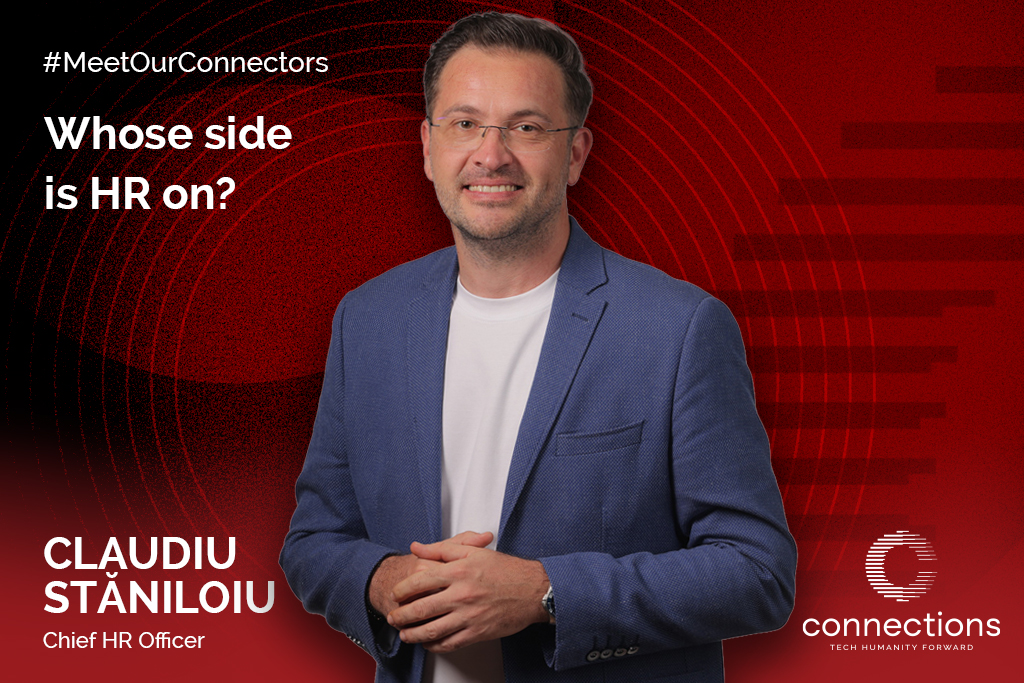
In a technology company undergoing constant evolution, the role of the HR department goes far beyond administration and becomes a strategic partner in the development of the organization and the people who build it every day. From the perspective of Claudiu Stăniloiu, Chief Human Resources Officer at Connections, this role requires balance, constant adaptation, and a deep understanding of the relationship between business, organizational culture, and employee experience.
An idea that has influenced him since the early stages of his career perfectly captures the way he views leadership and organizational relationships today: “People follow people, and people leave people, not companies.” This is precisely why he sees the role of Chief Human Resources Officer as a deeply strategic and people-focused one, built around collaboration, development, and continuous change.
In his day-to-day work, this perspective translates into a proactive approach to HR and to the relationship between business and people. For Claudiu, a high-performing HR department does not simply react to problems; it actively contributes to the company’s direction, the development of its people, and the creation of a healthy organizational culture. The role of a CHRO is, first and foremost, about close collaboration with company leadership and turning business objectives into real experiences for employees.
Organizational culture is built every day
In a tech organization that is constantly evolving, organizational culture becomes a living process, characterized by continuous adaptation to the company’s pace. Claudiu describes this transformation through the changes he observes in the way teams work: more efficient processes, less bureaucracy, fewer but more focused meetings, as well as an increasing ability to provide authentic feedback, delegate, and honestly acknowledge the moments when we should say, “We don’t know.”
Beyond procedures and workflows, however, he believes that true organizational culture can be seen in the relationships between people and in the way things function when formal control is absent. For him, a company’s culture is about respect, clarity, support, and mutual trust, and these are the elements that define an organization far more than any internal process.
In this context, building trust becomes one of the most important responsibilities of an HR leader. Claudiu describes trust as something that takes a long time to build and can be lost very easily, which is why authentic leadership requires consistency, involvement, and transparency. From delegation and taking responsibility for mistakes to recognizing colleagues’ contributions and providing clarity, every interaction contributes to strengthening a healthy and balanced environment.
Another important dimension of his role is finding the right balance between people’s needs and the company’s objectives. Claudiu believes that one of the most common misconceptions about the HR function is the question, “Whose side is HR on?” In reality, “HR is about balance. It is the function that sometimes has to make decisions that will not please everyone, but it is also the function that supports people within the company and supports the company in its relationship with its people and employees,” he explains.
Essentially, HR needs to understand and support both perspectives. It is a role that requires analysis, strategy, and risk management, but also the ability to build genuine bridges between the organization and its teams.
People, technology, and organizations ready for the future
Changes in the industry and technological developments are constantly transforming the role of HR. Claudiu sees artificial intelligence as real support for teams, particularly by eliminating repetitive activities and shifting the focus toward initiatives with greater impact on both people and the business. From his perspective, AI contributes to a more proactive approach and accelerates HR’s important transition toward People & Business Partnering.
All these experiences have also strengthened his perspective on leadership and on how people function within organizations. In his view, performance does not come exclusively from pressure, but from clarity, purpose, and leaders’ ability to build genuine connections with their teams. For Claudiu, a manager needs to understand that people need to be seen, heard, and supported, while the emotional impact a leader has on their team is often far greater than we might realize.
Ultimately, a technology company’s responsibility toward its people goes beyond business objectives. Clarity, respect, and psychological safety are, in Claudiu’s view, essential elements of any healthy organization. And the message he shares with his colleagues at Connections is a simple one: openness and honest communication, because HR is, above all, about people and for people.